Guest Post: SHADAC Survey Data Finder
Today's post is from our colleagues at SHADAC, who have developed a tool to help data users compare different surveys and find the data they need. Learn more, then try it out for yourself!
Federal surveys are critical for national and state-level monitoring of health insurance coverage, health care access and use, and health conditions and behaviors. Amid uncertainty about the future of federal health survey data, it's important to understand the details of these surveys, including what topic domains they gather. The State Health Access Data Assistance Center (SHADAC) has made exploring what data are available in federal health-related surveys easier for researchers, policymakers, advocates, and others through its interactive "Survey Data Finder" tool! This tool not only acts as an inventory of many federal health-related surveys, but it also highlights potential data gaps that could arise if surveys were discontinued or changed.
As a part of its State Alternatives for Health Data Continuity project funded by the Robert Wood Johnson Foundation, SHADAC (based at the University of Minnesota School of Public Health) conducted a data scan to review detailed documentation of a variety of federal health and health-related surveys. Findings from the scan were compiled into this tool, providing users with a detailed and easy-to-use method of understanding health domains covered in various federal health-related surveys.
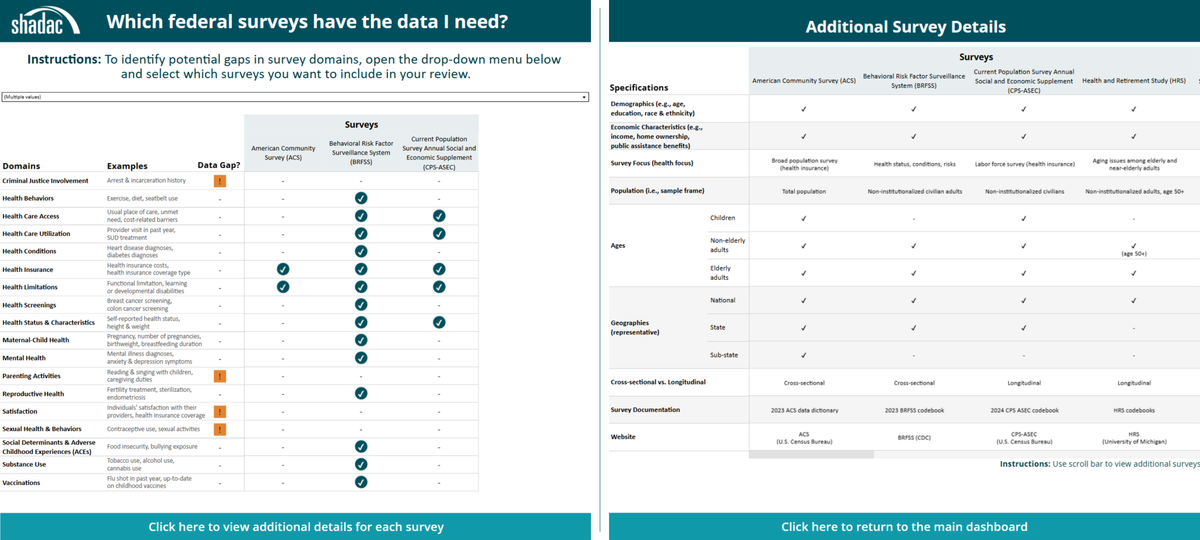
One of the main uses of the tool is to help users identify where they can access the health survey data they need, allowing them to view and compare which surveys cover domains of interest. For example, if users are interested in data describing individuals’ satisfaction with their provider or health insurance coverage (the tool’s “Satisfaction” domain), the tool shows that two surveys have satisfaction data or information: the Health and Retirement Study (HRS) (a survey about non-institutionalized elderly and near elderly adults) and the National Survey of Children’s Health (NSCH) (a survey about non-institutionalized children).
The Survey Data Finder also allows users to select and/or remove surveys from the generated results in order to simulate what data gaps could arise if certain surveys ended or became inaccessible. In the tool, a “data gap” is highlighted when none of the selected surveys collect data in a certain health domain. For example, if a user were to select only the American Community Survey (ACS), the Behavioral Risk Factor Surveillance System (BRFSS), and the Current Population Survey Annual Social and Economic Supplement (CPS-ASEC), the data gap column would flag four gaps in the health domains of criminal justice involvement, parenting activities, satisfaction, and sexual health and behaviors (see the “Data Gap?” column on the left side of the visual). If a user then kept the ACS and CPS-ASEC selected but de-selected the BRFSS, simulating what might happen if the BRFSS were discontinued, the number of health domains flagged for data gaps would more than triple to 13.
Along with providing information on what topic domains are covered by each survey and highlighting potential data gaps, this tool also catalogues key details for the included surveys, including sample characteristics, demographics, level of geography available, links to websites and survey documentation, and more in a separate specifications table (see the “Additional Survey Details” table on the right side of the visual) that users can access at the bottom of the main data table.
Find more information on how to use the Survey Data Finder in the Tutorial Video included on the tool’s webpage.
The best way to learn more about this useful tool is to use it, interact with it, and see what you can find. SHADAC welcomes any and all feedback on this tool—contact SHADAC here with any questions or comments.