Save Our Signs: New photos, new maps, and a renewed sense of purpose
The past four months have been a challenging and sobering time for the Save Our Signs team. Most of us live in Minneapolis and St. Paul and as the ICE occupation in Minnesota devastated our communities, we had to balance our professional work with our efforts to support our neighbors. At times, this meant slowing our pace on our ongoing efforts to combat censorship at National Park Service (NPS) sites. Throughout this past winter, we watched our government attempt to suppress those who seek to document the human rights abuses perpetuated by ICE. This suppression coincided with the administration’s efforts to erase documentation of past injustices and atrocities from National Park sites. The ICE occupation continues to cause ripple effects across our communities, and so we are continuing to balance our work with supporting our neighbors. While things are not back to normal in Minnesota, we feel a renewed sense of purpose in our SOS work.
To that end, we are excited to announce three project updates:
📷 New Database Means 2,500+ New Photos Dropped! 📷
We are excited to share that we have recently completed the project’s new backend database, which will enable us to curate and publish submitted photos much more quickly than before. These technical updates will support future SOS Archive enhancements to make the archive more usable for the public.
With the completion of this new backend database, we’ve begun processing and publishing the photos that volunteers have submitted since the initial September 2025 deadline. Today, we have published over 2,500 new photos to the SOS Archive, and are hard at work processing about 1,500 more that have been submitted over the past few months. Moving forward, we will process photos on an ongoing basis rather than in large batches, so you can check back regularly to see new photos in the archive!
The archive is not done - we continue to accept photos of NPS signs as well as photos documenting censorship (such as a blank space where a sign was removed) and creative resistance (such as art, or a new panel, that is a clear act of protest at an NPS site).
⚠️ What is at risk? New Storymap of Leaked NPS Database ⚠️
On March 2, an internal NPS dataset of materials flagged for review and potential removal or alteration was leaked to the public. It was first reported on by the Washington Post. The data can be accessed at the Internet Archive and SciOp.
To aid in interpreting this leaked dataset, the SOS team has created “Digging into the Leaked NPS Data,” a StoryMap visualization and walk-through of what is at risk and what the data reveals. Please use and share this StoryMap.
✨ Updated SOS Archive Map ✨
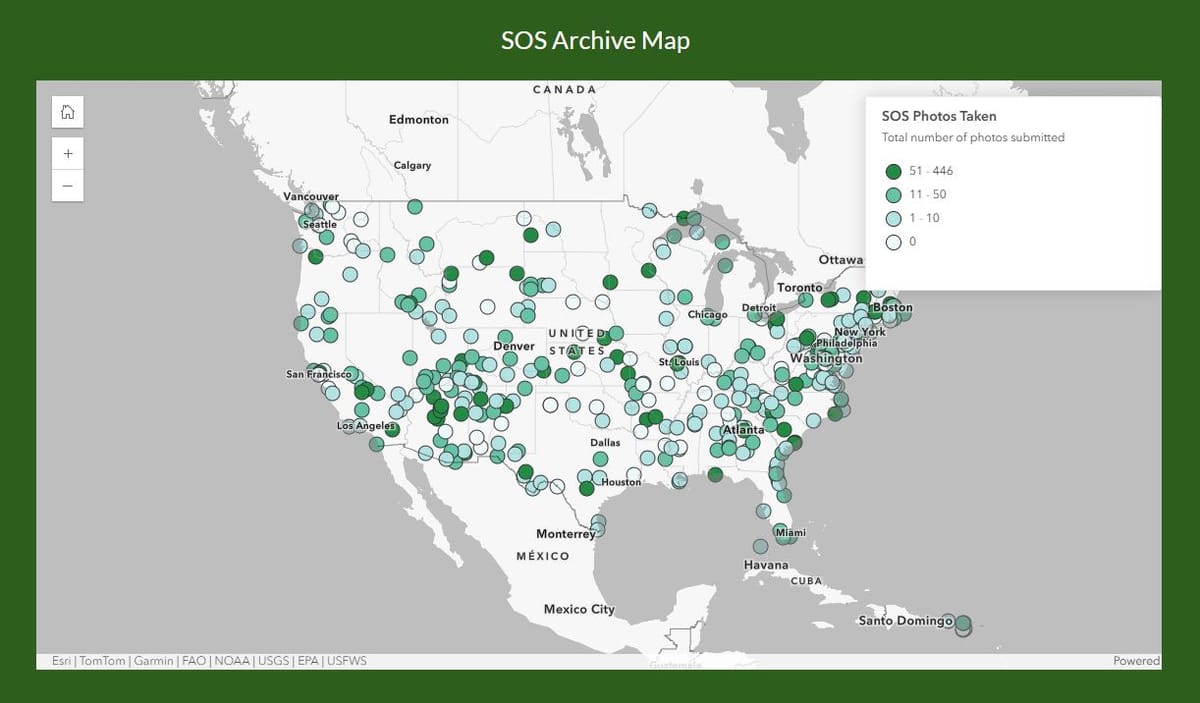
We’ve also updated our SOS Archive Map to better show where we still need photos. Darker green dots indicate we have more photos in the archive, while lighter shades indicate fewer photos, or even no photos. Click on a dot to view info about each site, including the number of photos submitted and links to the site’s SOS Archive and NPS webpages.
Comparing our SOS Archive Map to the leaked NPS data, we found that there are 5 at-risk parks with materials flagged for review where we do not have any photos saved yet:
- Chattahoochee River National Recreation Area (Georgia outside of Atlanta)
- Wilson's Creek National Battlefield (Missouri near Springfield)
- Buck Island Reef National Monument (US Virgin Islands)
- Salt River Bay National Historical Park and Ecological Preserve (US Virgin Islands)
- Christiansted National Historic Site (US Virgin Islands)
Can you help? Visit these sites and submit photos of signs to saveoursigns.org.
💪Use the SOS Archive to resist censorship! 💪
If you’re fired up and looking to get involved, there are a few ways to support our work:
- Fill in the gaps: Pick a site with few photos, see which signs we have photos of and which we’re still missing, and head out to the park to snap some pics.
- Answer the Resistance Rangers’ call: Adopt a Sign, Save a Story! Share your sign and earn your Resistance Ranger Badge.
- Revisit a park: Take pictures of removed panels and resistance art to contribute to the history of this attempted erasure.
- Stay tuned: There will be future volunteer opportunities to help curate and add metadata to the photo database.